WEBLEB
Accueil
Éditeur
Connexion
Pro
Français
English
Français
Español
Simulateur de voiture
11
Novaxfx
Ouvrir dans l'éditeur
Publiez votre code
0
Recommandé
28 January 2026
ULTRAKILL WebGL : Configuration du chargeur de jeu Unity et du canevas
30 November 2025
Formulaire de connexion HTML : Nom d’utilisateur/Adresse e-mail et mot de passe
21 July 2023
Formulaire avec arrière-plan vidéo
HTML
Copy
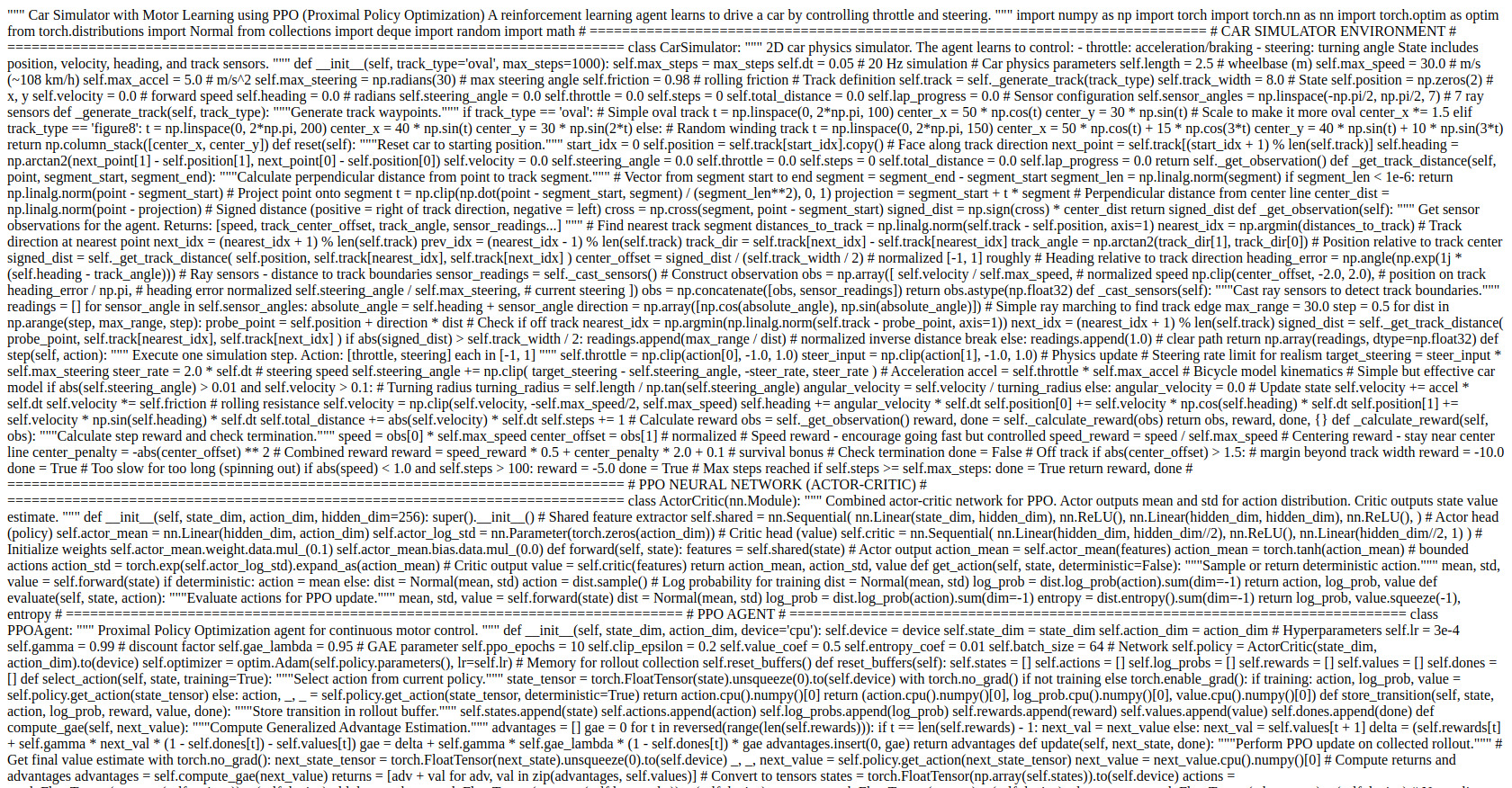
<!-- Replace with your HTML Code (Leave empty if not needed) --> """ Car Simulator with Motor Learning using PPO (Proximal Policy Optimization) A reinforcement learning agent learns to drive a car by controlling throttle and steering. """ import numpy as np import torch import torch.nn as nn import torch.optim as optim from torch.distributions import Normal from collections import deque import random import math # ============================================================================ # CAR SIMULATOR ENVIRONMENT # ============================================================================ class CarSimulator: """ 2D car physics simulator. The agent learns to control: - throttle: acceleration/braking - steering: turning angle State includes position, velocity, heading, and track sensors. """ def __init__(self, track_type='oval', max_steps=1000): self.max_steps = max_steps self.dt = 0.05 # 20 Hz simulation # Car physics parameters self.length = 2.5 # wheelbase (m) self.max_speed = 30.0 # m/s (~108 km/h) self.max_accel = 5.0 # m/s^2 self.max_steering = np.radians(30) # max steering angle self.friction = 0.98 # rolling friction # Track definition self.track = self._generate_track(track_type) self.track_width = 8.0 # State self.position = np.zeros(2) # x, y self.velocity = 0.0 # forward speed self.heading = 0.0 # radians self.steering_angle = 0.0 self.throttle = 0.0 self.steps = 0 self.total_distance = 0.0 self.lap_progress = 0.0 # Sensor configuration self.sensor_angles = np.linspace(-np.pi/2, np.pi/2, 7) # 7 ray sensors def _generate_track(self, track_type): """Generate track waypoints.""" if track_type == 'oval': # Simple oval track t = np.linspace(0, 2*np.pi, 100) center_x = 50 * np.cos(t) center_y = 30 * np.sin(t) # Scale to make it more oval center_x *= 1.5 elif track_type == 'figure8': t = np.linspace(0, 2*np.pi, 200) center_x = 40 * np.sin(t) center_y = 30 * np.sin(2*t) else: # Random winding track t = np.linspace(0, 2*np.pi, 150) center_x = 50 * np.cos(t) + 15 * np.cos(3*t) center_y = 40 * np.sin(t) + 10 * np.sin(3*t) return np.column_stack([center_x, center_y]) def reset(self): """Reset car to starting position.""" start_idx = 0 self.position = self.track[start_idx].copy() # Face along track direction next_point = self.track[(start_idx + 1) % len(self.track)] self.heading = np.arctan2(next_point[1] - self.position[1], next_point[0] - self.position[0]) self.velocity = 0.0 self.steering_angle = 0.0 self.throttle = 0.0 self.steps = 0 self.total_distance = 0.0 self.lap_progress = 0.0 return self._get_observation() def _get_track_distance(self, point, segment_start, segment_end): """Calculate perpendicular distance from point to track segment.""" # Vector from segment start to end segment = segment_end - segment_start segment_len = np.linalg.norm(segment) if segment_len < 1e-6: return np.linalg.norm(point - segment_start) # Project point onto segment t = np.clip(np.dot(point - segment_start, segment) / (segment_len**2), 0, 1) projection = segment_start + t * segment # Perpendicular distance from center line center_dist = np.linalg.norm(point - projection) # Signed distance (positive = right of track direction, negative = left) cross = np.cross(segment, point - segment_start) signed_dist = np.sign(cross) * center_dist return signed_dist def _get_observation(self): """ Get sensor observations for the agent. Returns: [speed, track_center_offset, track_angle, sensor_readings...] """ # Find nearest track segment distances_to_track = np.linalg.norm(self.track - self.position, axis=1) nearest_idx = np.argmin(distances_to_track) # Track direction at nearest point next_idx = (nearest_idx + 1) % len(self.track) prev_idx = (nearest_idx - 1) % len(self.track) track_dir = self.track[next_idx] - self.track[nearest_idx] track_angle = np.arctan2(track_dir[1], track_dir[0]) # Position relative to track center signed_dist = self._get_track_distance( self.position, self.track[nearest_idx], self.track[next_idx] ) center_offset = signed_dist / (self.track_width / 2) # normalized [-1, 1] roughly # Heading relative to track direction heading_error = np.angle(np.exp(1j * (self.heading - track_angle))) # Ray sensors - distance to track boundaries sensor_readings = self._cast_sensors() # Construct observation obs = np.array([ self.velocity / self.max_speed, # normalized speed np.clip(center_offset, -2.0, 2.0), # position on track heading_error / np.pi, # heading error normalized self.steering_angle / self.max_steering, # current steering ]) obs = np.concatenate([obs, sensor_readings]) return obs.astype(np.float32) def _cast_sensors(self): """Cast ray sensors to detect track boundaries.""" readings = [] for sensor_angle in self.sensor_angles: absolute_angle = self.heading + sensor_angle direction = np.array([np.cos(absolute_angle), np.sin(absolute_angle)]) # Simple ray marching to find track edge max_range = 30.0 step = 0.5 for dist in np.arange(step, max_range, step): probe_point = self.position + direction * dist # Check if off track nearest_idx = np.argmin(np.linalg.norm(self.track - probe_point, axis=1)) next_idx = (nearest_idx + 1) % len(self.track) signed_dist = self._get_track_distance( probe_point, self.track[nearest_idx], self.track[next_idx] ) if abs(signed_dist) > self.track_width / 2: readings.append(max_range / dist) # normalized inverse distance break else: readings.append(1.0) # clear path return np.array(readings, dtype=np.float32) def step(self, action): """ Execute one simulation step. Action: [throttle, steering] each in [-1, 1] """ self.throttle = np.clip(action[0], -1.0, 1.0) steer_input = np.clip(action[1], -1.0, 1.0) # Physics update # Steering rate limit for realism target_steering = steer_input * self.max_steering steer_rate = 2.0 * self.dt # steering speed self.steering_angle += np.clip( target_steering - self.steering_angle, -steer_rate, steer_rate ) # Acceleration accel = self.throttle * self.max_accel # Bicycle model kinematics # Simple but effective car model if abs(self.steering_angle) > 0.01 and self.velocity > 0.1: # Turning radius turning_radius = self.length / np.tan(self.steering_angle) angular_velocity = self.velocity / turning_radius else: angular_velocity = 0.0 # Update state self.velocity += accel * self.dt self.velocity *= self.friction # rolling resistance self.velocity = np.clip(self.velocity, -self.max_speed/2, self.max_speed) self.heading += angular_velocity * self.dt self.position[0] += self.velocity * np.cos(self.heading) * self.dt self.position[1] += self.velocity * np.sin(self.heading) * self.dt self.total_distance += abs(self.velocity) * self.dt self.steps += 1 # Calculate reward obs = self._get_observation() reward, done = self._calculate_reward(obs) return obs, reward, done, {} def _calculate_reward(self, obs): """Calculate step reward and check termination.""" speed = obs[0] * self.max_speed center_offset = obs[1] # normalized # Speed reward - encourage going fast but controlled speed_reward = speed / self.max_speed # Centering reward - stay near center line center_penalty = -abs(center_offset) ** 2 # Combined reward reward = speed_reward * 0.5 + center_penalty * 2.0 + 0.1 # survival bonus # Check termination done = False # Off track if abs(center_offset) > 1.5: # margin beyond track width reward = -10.0 done = True # Too slow for too long (spinning out) if abs(speed) < 1.0 and self.steps > 100: reward = -5.0 done = True # Max steps reached if self.steps >= self.max_steps: done = True return reward, done # ============================================================================ # PPO NEURAL NETWORK (ACTOR-CRITIC) # ============================================================================ class ActorCritic(nn.Module): """ Combined actor-critic network for PPO. Actor outputs mean and std for action distribution. Critic outputs state value estimate. """ def __init__(self, state_dim, action_dim, hidden_dim=256): super().__init__() # Shared feature extractor self.shared = nn.Sequential( nn.Linear(state_dim, hidden_dim), nn.ReLU(), nn.Linear(hidden_dim, hidden_dim), nn.ReLU(), ) # Actor head (policy) self.actor_mean = nn.Linear(hidden_dim, action_dim) self.actor_log_std = nn.Parameter(torch.zeros(action_dim)) # Critic head (value) self.critic = nn.Sequential( nn.Linear(hidden_dim, hidden_dim//2), nn.ReLU(), nn.Linear(hidden_dim//2, 1) ) # Initialize weights self.actor_mean.weight.data.mul_(0.1) self.actor_mean.bias.data.mul_(0.0) def forward(self, state): features = self.shared(state) # Actor output action_mean = self.actor_mean(features) action_mean = torch.tanh(action_mean) # bounded actions action_std = torch.exp(self.actor_log_std).expand_as(action_mean) # Critic output value = self.critic(features) return action_mean, action_std, value def get_action(self, state, deterministic=False): """Sample or return deterministic action.""" mean, std, value = self.forward(state) if deterministic: action = mean else: dist = Normal(mean, std) action = dist.sample() # Log probability for training dist = Normal(mean, std) log_prob = dist.log_prob(action).sum(dim=-1) return action, log_prob, value def evaluate(self, state, action): """Evaluate actions for PPO update.""" mean, std, value = self.forward(state) dist = Normal(mean, std) log_prob = dist.log_prob(action).sum(dim=-1) entropy = dist.entropy().sum(dim=-1) return log_prob, value.squeeze(-1), entropy # ============================================================================ # PPO AGENT # ============================================================================ class PPOAgent: """ Proximal Policy Optimization agent for continuous motor control. """ def __init__(self, state_dim, action_dim, device='cpu'): self.device = device self.state_dim = state_dim self.action_dim = action_dim # Hyperparameters self.lr = 3e-4 self.gamma = 0.99 # discount factor self.gae_lambda = 0.95 # GAE parameter self.ppo_epochs = 10 self.clip_epsilon = 0.2 self.value_coef = 0.5 self.entropy_coef = 0.01 self.batch_size = 64 # Network self.policy = ActorCritic(state_dim, action_dim).to(device) self.optimizer = optim.Adam(self.policy.parameters(), lr=self.lr) # Memory for rollout collection self.reset_buffers() def reset_buffers(self): self.states = [] self.actions = [] self.log_probs = [] self.rewards = [] self.values = [] self.dones = [] def select_action(self, state, training=True): """Select action from current policy.""" state_tensor = torch.FloatTensor(state).unsqueeze(0).to(self.device) with torch.no_grad() if not training else torch.enable_grad(): if training: action, log_prob, value = self.policy.get_action(state_tensor) else: action, _, _ = self.policy.get_action(state_tensor, deterministic=True) return action.cpu().numpy()[0] return (action.cpu().numpy()[0], log_prob.cpu().numpy()[0], value.cpu().numpy()[0]) def store_transition(self, state, action, log_prob, reward, value, done): """Store transition in rollout buffer.""" self.states.append(state) self.actions.append(action) self.log_probs.append(log_prob) self.rewards.append(reward) self.values.append(value) self.dones.append(done) def compute_gae(self, next_value): """Compute Generalized Advantage Estimation.""" advantages = [] gae = 0 for t in reversed(range(len(self.rewards))): if t == len(self.rewards) - 1: next_val = next_value else: next_val = self.values[t + 1] delta = (self.rewards[t] + self.gamma * next_val * (1 - self.dones[t]) - self.values[t]) gae = delta + self.gamma * self.gae_lambda * (1 - self.dones[t]) * gae advantages.insert(0, gae) return advantages def update(self, next_state, done): """Perform PPO update on collected rollout.""" # Get final value estimate with torch.no_grad(): next_state_tensor = torch.FloatTensor(next_state).unsqueeze(0).to(self.device) _, _, next_value = self.policy.get_action(next_state_tensor) next_value = next_value.cpu().numpy()[0] # Compute returns and advantages advantages = self.compute_gae(next_value) returns = [adv + val for adv, val in zip(advantages, self.values)] # Convert to tensors states = torch.FloatTensor(np.array(self.states)).to(self.device) actions = torch.FloatTensor(np.array(self.actions)).to(self.device) old_log_probs = torch.FloatTensor(np.array(self.log_probs)).to(self.device) returns = torch.FloatTensor(returns).to(self.device) advantages = torch.FloatTensor(advantages).to(self.device) # Normalize advantages advantages = (advantages - advantages.mean()) / (advantages.std() + 1e-8) # PPO training epochs dataset_size = len(self.states) indices = np.arange(dataset_size) for _ in range(self.ppo_epochs): np.random.shuffle(indices) for start in range(0, dataset_size, self.batch_size): end = start + self.batch_size batch_idx = indices[start:end] batch_states = states[batch_idx] batch_actions = actions[batch_idx] batch_old_log_probs = old_log_probs[batch_idx] batch_returns = returns[batch_idx] batch_advantages = advantages[batch_idx] # Evaluate current policy log_probs, values, entropy = self.policy.evaluate( batch_states, batch_actions ) # PPO clipped objective ratio = torch.exp(log_probs - batch_old_log_probs) surr1 = ratio * batch_advantages surr2 = torch.clamp(ratio, 1 - self.clip_epsilon, 1 + self.clip_epsilon) * batch_advantages actor_loss = -torch.min(surr1, surr2).mean() # Value loss value_loss = nn.MSELoss()(values, batch_returns) # Entropy bonus for exploration entropy_loss = -entropy.mean() # Total loss loss = (actor_loss + self.value_coef * value_loss + self.entropy_coef * entropy_loss) # Optimize self.optimizer.zero_grad() loss.backward() nn.utils.clip_grad_norm_(self.policy.parameters(), 0.5) self.optimizer.step() # Clear buffers self.reset_buffers() return { 'actor_loss': actor_loss.item(), 'value_loss': value_loss.item(), 'entropy': entropy.mean().item() } # ============================================================================ # TRAINING LOOP # ============================================================================ def train_car_simulator(num_episodes=1000, render_interval=100): """ Main training function. Architecture: 1. Environment generates states from car physics 2. Agent outputs throttle and steering commands 3. Car responds with new states 4. Reward based on speed and track position 5. PPO updates policy to maximize reward """ device = torch.device('cuda' if torch.cuda.is_available() else 'cpu') print(f"Training on {device}") # Create environment env = CarSimulator(track_type='oval', max_steps=1000) # Get dimensions from environment obs = env.reset() state_dim = len(obs) action_dim = 2 # [throttle, steering] print(f"State dim: {state_dim}, Action dim: {action_dim}") # Create agent agent = PPOAgent(state_dim, action_dim, device=device) # Training stats episode_rewards = [] episode_lengths = [] for episode in range(num_episodes): state = env.reset() episode_reward = 0 episode_length = 0 done = False # Collect rollout while not done: # Agent selects action action, log_prob, value = agent.select_action(state, training=True) # Environment step next_state, reward, done, _ = env.step(action) # Store transition agent.store_transition(state, action, log_prob, reward, value, done) episode_reward += reward episode_length += 1 state = next_state # Update policy after collecting enough data or episode end if len(agent.states) >= 2048 or done: if len(agent.states) > 0: agent.update(next_state, done) episode_rewards.append(episode_reward) episode_lengths.append(episode_length) # Logging if (episode + 1) % 10 == 0: avg_reward = np.mean(episode_rewards[-10:]) avg_length = np.mean(episode_lengths[-10:]) print(f"Episode {episode+1}: Reward={avg_reward:.1f}, " f"Steps={avg_length:.0f}, Distance={env.total_distance:.1f}m") # Save checkpoint if (episode + 1) % 500 == 0: torch.save(agent.policy.state_dict(), f'car_policy_ep{episode+1}.pth') # Final save torch.save(agent.policy.state_dict(), 'car_policy_final.pth') return agent, episode_rewards # ============================================================================ # EVALUATION / INFERENCE # ============================================================================ def evaluate_policy(policy_path='car_policy_final.pth', num_episodes=3): """Run trained policy.""" device = torch.device('cpu') env = CarSimulator(track_type='oval', max_steps=2000) obs = env.reset() state_dim = len(obs) action_dim = 2 # Load policy policy = ActorCritic(state_dim, action_dim).to(device) policy.load_state_dict(torch.load(policy_path, map_location=device)) policy.eval() for ep in range(num_episodes): state = env.reset() done = False total_reward = 0 step = 0 print(f"\n--- Episode {ep+1} ---") while not done: state_tensor = torch.FloatTensor(state).unsqueeze(0).to(device) with torch.no_grad(): action, _, _ = policy.get_action(state_tensor, deterministic=True) state, reward, done, _ = env.step(action.cpu().numpy()[0]) total_reward += reward step += 1 if step % 100 == 0: print(f" Step {step}: pos=({env.position[0]:.1f}, {env.position[1]:.1f}), " f"vel={env.velocity:.1f}m/s") print(f"Total reward: {total_reward:.1f}, Steps: {step}") # ============================================================================ # MAIN # ============================================================================ if __name__ == "__main__": # Training print("=" * 50) print("MOTOR LEARNING: CAR SIMULATOR") print("Algorithm: PPO (Proximal Policy Optimization)") print("=" * 50) # Uncomment to train: # agent, rewards = train_car_simulator(num_episodes=1000) # Uncomment to evaluate: # evaluate_policy('car_policy_final.pth') # Quick demo with untrained policy print("\nRunning demo with random policy...") env = CarSimulator(track_type='oval') state = env.reset() for step in range(200): # Random action action = np.random.uniform(-0.5, 1.0, size=2) # slight forward bias state, reward, done, _ = env.step(action) if step % 50 == 0: print(f"Step {step}: speed={env.velocity:.1f}m/s, " f"pos=({env.position[0]:.1f}, {env.position[1]:.1f})") if done: print(f"Episode ended at step {step}") break
CSS
Copy
<!-- Replace with your CSS Code (Leave empty if not needed) -->
JS
Copy
/* Replace with your JS Code (Leave empty if not needed) */